> For the complete documentation index, see [llms.txt](https://planetary-defense-guide.gitbook.io/guide/llms.txt). Markdown versions of documentation pages are available by appending `.md` to page URLs; this page is available as [Markdown](https://planetary-defense-guide.gitbook.io/guide/web-game/introduction.md).
# Introduction
Planetary Defense V3 is a Web3 strategy game built on the WAX blockchain. The game is currently in the beta phase and can be accessed at this address:
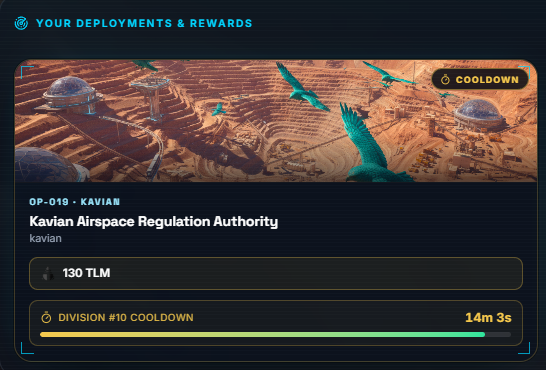
It's a fully on-chain title where you act as a commander who stakes NFTs to generate resources, assembles combat divisions, forges equipment, and launches PvE missions across different planets to earn **TLM**, **DEF** and **NFT** rewards.
V3 brings a redesigned interface, a more visual forge, smoother division management, and a global leaderboard.
The gameplay rests on three pillars:
* **NFT economy** — stake your lands and units to make them playable and produce resources.
* **PvE missions** — solo or multi-instance, including community mega-raids.
* **PvP raids** — attack rival lands, steal resources, and dominate the leaderboard.
Planetary Defense V3 introduces a complete transition to an on-chain interstellar strategy experience on WAX, significantly expanding the core competitive gameplay and asset management compared to previous versions.
{% hint style="info" %}
Note: The game does not yet include all available features; therefore, it is recommended to explore the game's features in the appropriate sections.
{% endhint %}
### 🌌 The Galaxy & Economy
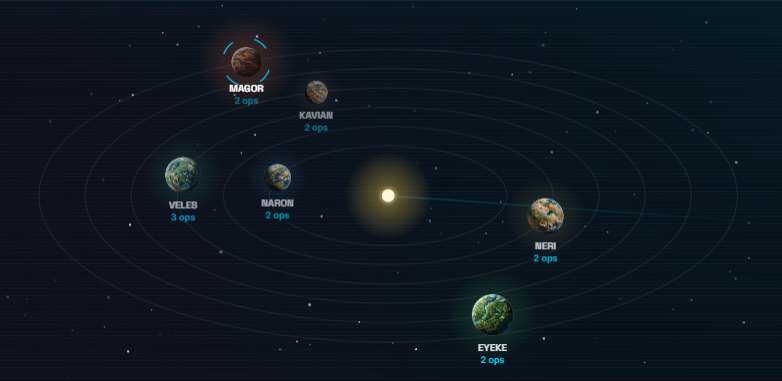
The galaxy of Planetary Defense V3 spans six planets available for conquest and resource extraction: Magor, Eyeke, Kavian, Naron, Neri, and Veles. Mission and raid rewards are paid out in TLM and DEF, with DEF tradeable on the Alcor exchange.
### 📈 Military Statistics Tracking
The V3 interface introduces, for the first time, clear and centralized tracking of your empire's military statistics:
* Total Defense & Total Attack — Two global metrics shown on the Dashboard that calculate the overall power of your deployed fleet and defenses.
* Divisions Management — A dedicated screen to create, upgrade, and structure custom military divisions for offensive or defensive purposes.
### 🗺️ Missions Expansion
Missions have been categorized and branched out to offer different dynamics depending on the assets you own:
* Claims Missions & Planetary Missions — Galaxy-scale missions tied to extracting or claiming resources.
* Community Missions — Special tasks linked to synergies between community members and in-game factions.
### 🧭 Land Management (Lands & Buildings)
The section dedicated to managing NFT Lands has been radically enhanced with the introduction of:
* Buildings — The ability to construct structures directly on your plots to unlock production bonuses, store resources, or raise defensive barriers.
* Chests — An upgrade system for Chests that increases the rarity and volume of drops and reward payouts.
{% hint style="info" %}
This feature is not live in Web Game V3 yet.
{% endhint %}
### ⚔️ Raids and PvP Mode
V3 shifts strongly toward interactive, aggressive gameplay:
* Raids — A mechanic for organizing coordinated fleet assaults against neutral territories or bosses.
* PvP (Player vs Player) — A direct competitive feature that lets you attack other players' lands, plunder their accumulated resources, and climb a real-time global Leaderboard to prove your supremacy.
{% hint style="info" %}
This feature is not live in Web Game V3 yet.
{% endhint %}
### ⚒️ The Forge
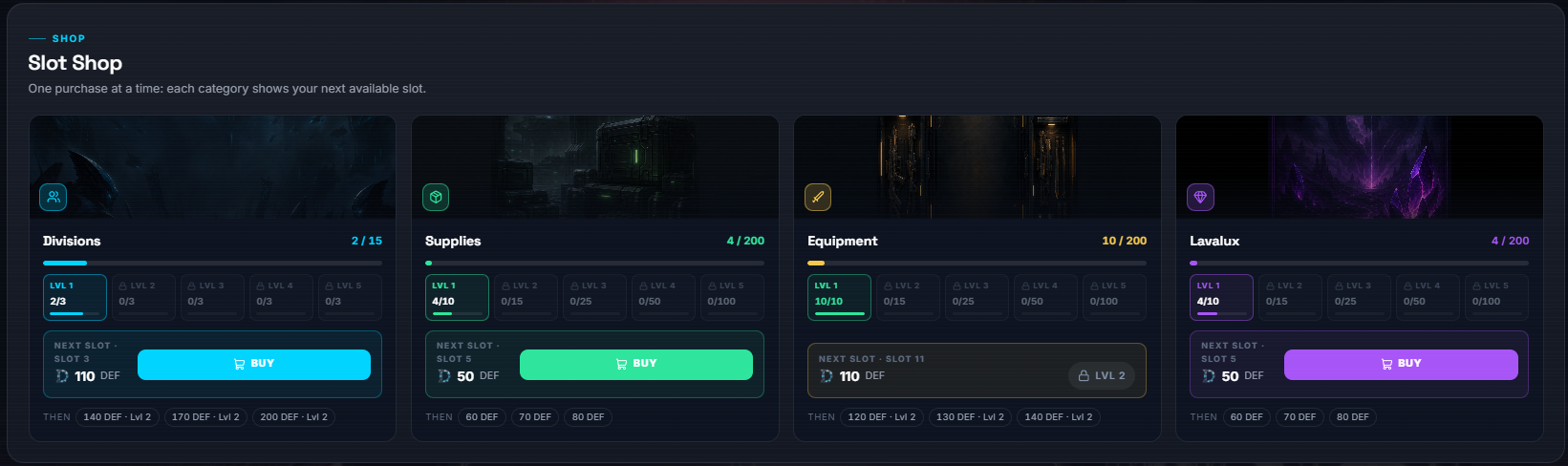
An entirely new section built around capacity. You unlock Forge levels with TLM, then spend DEF to buy slots in four categories (Divisions, Equipment, Supplies, Services/Lavalux). More slots means more divisions on the field and more gear on your mercenaries.
{% hint style="info" %}
Note: The information on this page reflects the current state of Planetary Defense's development. As new features are actually released and the game evolves, some details here may change, and this page will be updated to stay accurate.
{% endhint %}
---
# Agent Instructions
This documentation is published with GitBook. GitBook is the documentation platform designed so that both humans and AI agents can read, navigate, and reason over technical content effectively. Learn more at gitbook.com.
## Querying This Documentation
If you need additional information that is not directly available in this page, you can query the documentation by asking a question.
Perform an HTTP GET request on the following URL with the `ask` and `goal` query parameters:
```
GET https://planetary-defense-guide.gitbook.io/guide/web-game/introduction.md?ask=&goal=
```
`ask` is the immediate question: it should be specific, self-contained, and written in natural language.
`goal` is what the user is ultimately trying to achieve, the reason they need the answer. Sharing it helps GitBook give you a better, more relevant answer. A goal is most helpful when it describes the outcome the user wants rather than restating the question. For example, with `ask=how do I create an API token`, a goal like `automate deployments from our CI pipeline` lets GitBook tailor the answer to that use case.
The response will contain a direct answer to the question and relevant excerpts and sources from the documentation.
Use this mechanism when the answer is not explicitly present in the current page, you need clarification or additional context, or you want to retrieve related documentation sections.