> For the complete documentation index, see [llms.txt](https://planetary-defense-guide.gitbook.io/guide/llms.txt). Markdown versions of documentation pages are available by appending `.md` to page URLs; this page is available as [Markdown](https://planetary-defense-guide.gitbook.io/guide/web-game/divisions-overview.md).
# Divisions Overview
In Planetary Defense, a **Division** is a core operational unit or group you build, manage, and assign leaders to for carrying out missions and strategic battles.
## Key Details About Divisions
* **Function:** They act as your primary workforce or military units used to engage in gameplay mechanics, execute strategic missions, and earn rewards like TLM and DEF.
* **Management:** Players can create, manage default configurations, and stake or unstake their division assets directly through the game interface.
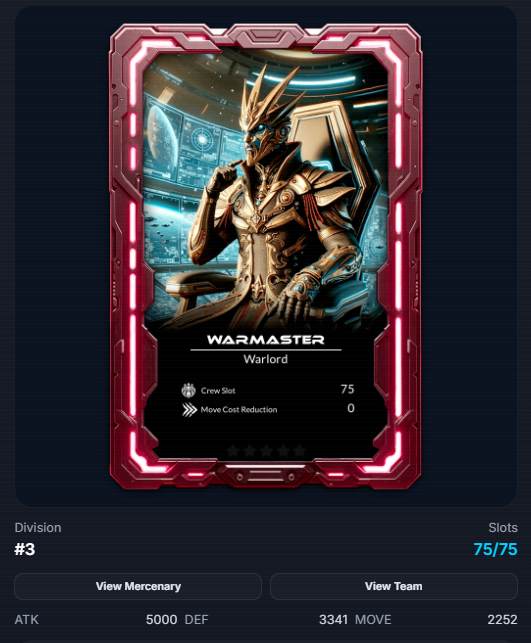
The division screen looks like this:
Each division is commanded by a **Warlord**, who determines the number of available **slots** for that **Division**. Think of the Warlord as the container for the Division. The number of slots defines the maximum number of Mercenaries you can assign, and Warlords have varying slot counts based on their rarity. These slots can also be increased by Ascending the NFT.
The Warlord assigns the Division an identification code followed by the symbol #. Try to see this code as an identifying ID of that Division.
The Division shows the total amount of **ATK** (attack), **DEF** (defense) and **MOVE** (move cost). This will then determine whether or not the missions are accessible.
It's also important to note that the Division **MOVE** will be added to the **Base Cooldown** of each mission. But we'll look at this in detail later. The more Divisions we configure, the more missions we'll be able to do, as long as the necessary requirements are met. All Divisions will be visible in the **My Divisions** section.
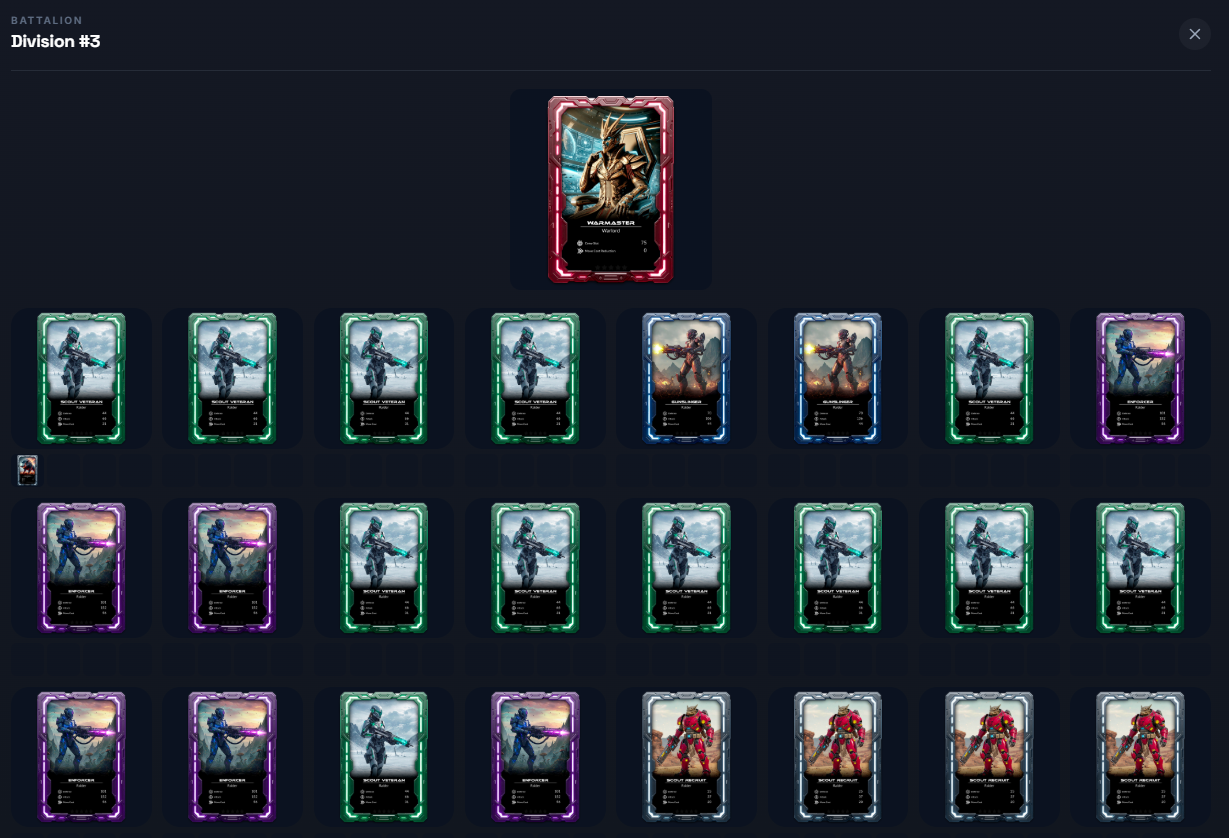
You can also click on **View Team** to see how your division is composed, or you can click on **View Mercenary** to edit your division and all your troops.
{% hint style="info" %}
Note: The information on this page reflects the current state of Planetary Defense's development. As new features are actually released and the game evolves, some details here may change, and this page will be updated to stay accurate.
{% endhint %}
---
# Agent Instructions
This documentation is published with GitBook. GitBook is the documentation platform designed so that both humans and AI agents can read, navigate, and reason over technical content effectively. Learn more at gitbook.com.
## Querying This Documentation
If you need additional information that is not directly available in this page, you can query the documentation by asking a question.
Perform an HTTP GET request on the following URL with the `ask` and `goal` query parameters:
```
GET https://planetary-defense-guide.gitbook.io/guide/web-game/divisions-overview.md?ask=&goal=
```
`ask` is the immediate question: it should be specific, self-contained, and written in natural language.
`goal` is what the user is ultimately trying to achieve, the reason they need the answer. Sharing it helps GitBook give you a better, more relevant answer. A goal is most helpful when it describes the outcome the user wants rather than restating the question. For example, with `ask=how do I create an API token`, a goal like `automate deployments from our CI pipeline` lets GitBook tailor the answer to that use case.
The response will contain a direct answer to the question and relevant excerpts and sources from the documentation.
Use this mechanism when the answer is not explicitly present in the current page, you need clarification or additional context, or you want to retrieve related documentation sections.